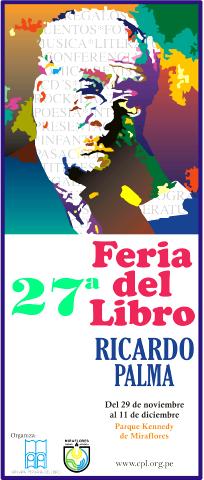
My visit to Lima coincided with the 27th edition of an annual book fair, the Feria del Libro Ricardo Palma. The Book Fair is held at Kennedy Park in the heart of Miraflores. The fair is held in late November and early December. This year's edition attracted over 100,000 visitors, according to the Camara Peruana del Libro, the Peruvian Book Association, organizers of the event.
Being an avid reader, I always purchase books when I travel in Latin America, and this time was no exception. In fact, I visited the Book Fair every day leaving with one or two purchases each time. A month later, when it was time to pack to come home, I discovered I had bought over 30 books! Since they weighed so much, I couldn't put them in my luggage and had to hand-carry most of them on the plane.
No sacrifice is too great for a good book, and I am happy to report that some of the volumes had to do with Peruvian cuisine. Surprised?
There was a plethora of books about Peruvian cooking on sale, in Spanish as well as in English. I could still be buying books today, and not have all the available titles. However, the ones I did purchase will be making appearances on this blog in future posts.
In the meantime, allow me to list the titles:
De Tamales y Tamaleros: Tres Historias de Vida (Tamales and Tamaleros: Three Life Stories), by anthropologist Humerto Rodríguez Pastor and published by the Universidad San Martín de Porres (USMP), combines gastronomy and cultural anthropology. At the doorway of almost every bakery in Peru is the ubiquitous tamalero, the tamale vendor. The tamalero is an independent agent, preparing tamales at home, and carrying them in large reed baskets to sell outside of bakeries throughout Peru. This book looks into the lives of three tamaleros who tell their stories and how they became tamaleros, and what their relationship is with this very traditional food.
La Cocina de los Incas: Costumbres Gastrónomicos y Técnicas Culinarias (Inca Cuisine: Gastronomic Customs and Techniques), by historian Rosario Olivas Weston and also published by USMP, is a thin volume that takes a careful and detailed look into the cooking techniques used by the Incas, their dishes, the role food played in Inca culture, and its legacy in contemporary Peruvian cuisine.
I was fortunate to interview Dr. Olivas Weston, who told me this book is intended to be a manual of the Inca kitchen. My conversation with Dr. Olivas Weston will be posted at a later date.
La Cocina en el Virreinato de Perú (Cuisine in the Viceroy of Peru), also by Rosario Olivas Weston and published by USMP, is a historic account that begins with the cuisine of Spain just prior to the arrival of the Spanish in the Americas, then moves to discuss the food eaten by the Spanish during the various expeditions to Peru, and how the first exchange between Spanish and indigenous cuisines occurred during that critical transitional period. Finally, the book looks at all aspects of cuisine during the Viceregal period, including tools, customs, dishes, and recipes.
De la Mar y la Mesa: Jocondas Historias con Antiguas Recetas (About the Sea and the Table: Jovial Tales and Old-Time Recipes), by Ricardo Alcalde Mongrut is another USMP title. The late Alcalde Mongrut was a journalist who, using the pseudonym El Compadre Guisao or The Cooking Buddy, wrote a series of humorous essays peppered with very traditional Lima characters and slang about Peruvian cuisine. He also included classic recipes. This book is a compilation of those essays.
Diccionario de Gastronomía Peruana Tradicional (Dictionary of Traditional Peruvian Gastronomy), my final USMP title, by Sergio Zapata Acha, who spent ten years working on this volume of over 3000 entries. The dictionary covers the description and origins of traditional dishes; as well as, descriptions and uses of food products. I have a feeling I will be referring to this volume often in 2007. I sometimes get e-mails from people interested in the history of a dish, and this volume is destined to be a great help.
Del Anticucho y de las Entradas Calientes (About Anticuchos and Hot Entrées), by Gastón Acurio, is a book I discovered the day I was leaving Lima. It is one of a ten-volume cookbook published by the leading newspaper in Peru, El Comercio. I was told the ten volumes had been available in early- and mid-2006, so I was only able to get this one title, but it has great recipes for different types of anticuchos (they aren't all made of beef heart any more!) as well as other Peruvian main dishes.
Newly published by El Comercio is a ten volume encyclopedia compiled by Gastón Acurio about Peruvian cuisine. Each volume has photos, recipes, and history. Unfortunately, the last three volumes have yet to be released, but I did get the first seven:
La Cocina Criolla, (Creole Cooking)
La Cocina de las Cebicherías, (Cebichería-Style Seafood Cooking)
La Cocina de las Chifas, (Chifa-Style Cooking)
La Cocina Nikkei, (Nikkei Cooking)
La Cocina Casera, (Home-Style Cooking)
La Cocina de la Calle, (Street Food)
La Cocina Norteña, (Northern-Style Cooking)
Finally, the two jewels in my Peru Food book crown:
The Art of Peruvian Cuisine by Tony Custer, the lavishly-illustrated, classic Peruvian cookbook. This book is a must-have for true Peruvian food aficionados. To read an earlier post about this book, you can click here.
Perú Mucho Gusto published by the Peruvian Comission for the Promotion of Peru (Prom Perú), another behemoth of a book with photos, recipes and features of leading Peruvian chefs. I also have an earlier post about this book at this link.
I have a lot of reading to do! (And, I didn't mention all the non-food related books I bought!)
Peru.Food@gmail.com
.
.
.
Click here for the Peru Food main page.
TAGS: Peru, Peruvian, food, cooking, cuisine, cocina, comida, gastronomía, peruana
TAGS: Peru, Peruvian, food, cooking, cuisine, cocina, comida, gastronomía, peruana